Smart Technology Meets Sustainable Operations in India's Office Market

India’s smart building market was valued at $12.5 billion in 2024 and is projected to reach $109 billion by 2033  growing at a 24% CAGR. That trajectory is not speculative: it is being driven by concrete forces. GCCs signing net-zero commitments, BEE energy-performance mandates, and the Smart Cities Mission are combining to make intelligent building infrastructure a non-negotiable requirement for Grade-A commercial assets.

The business case in India is clear. The IGBC estimates smart automation can enhance overall building efficiency by 40%. AI-enabled energy management systems can cut commercial building power consumption by 20–30% in India where electricity tariffs have risen significantly and peak-demand charges are substantial. For a 50,000 sq ft GCC office, a 25% reduction in energy spend can mean savings of ₹40–60 lakh annually, against a typical smart systems investment that amortises within 3–4 years.

The Colliers India 2026 office outlook (Business Standard, March 2026) explicitly identifies “tech-enabled workspaces” as one of five structural drivers of India’s office market growth noting that ESG performance is evolving from a compliance metric to a true value driver influencing asset valuations and investor preference. GCC tenants with global net-zero mandates are increasingly requiring landlords to provide live energy consumption dashboards as a precondition of lease.

For interior designers, this has a fundamental implication: sensor placement, control-zone mapping, and data dashboard requirements are interior design decisions that must be made at the same time as spatial planning and reflected in the fit-out brief and BOQ, not retrofitted after handover.

India Design Context

India’s traditional architectural repertoire, the Mughal garden, the Chettinad courtyard, Rajasthani jalis  is a deep wellspring of biophilic precedent. Contemporary Indian offices like Infosys Mysore Campus and Suzlon One Earth demonstrate that biophilic design at scale is entirely achievable within Indian construction budgets and climatic conditions.

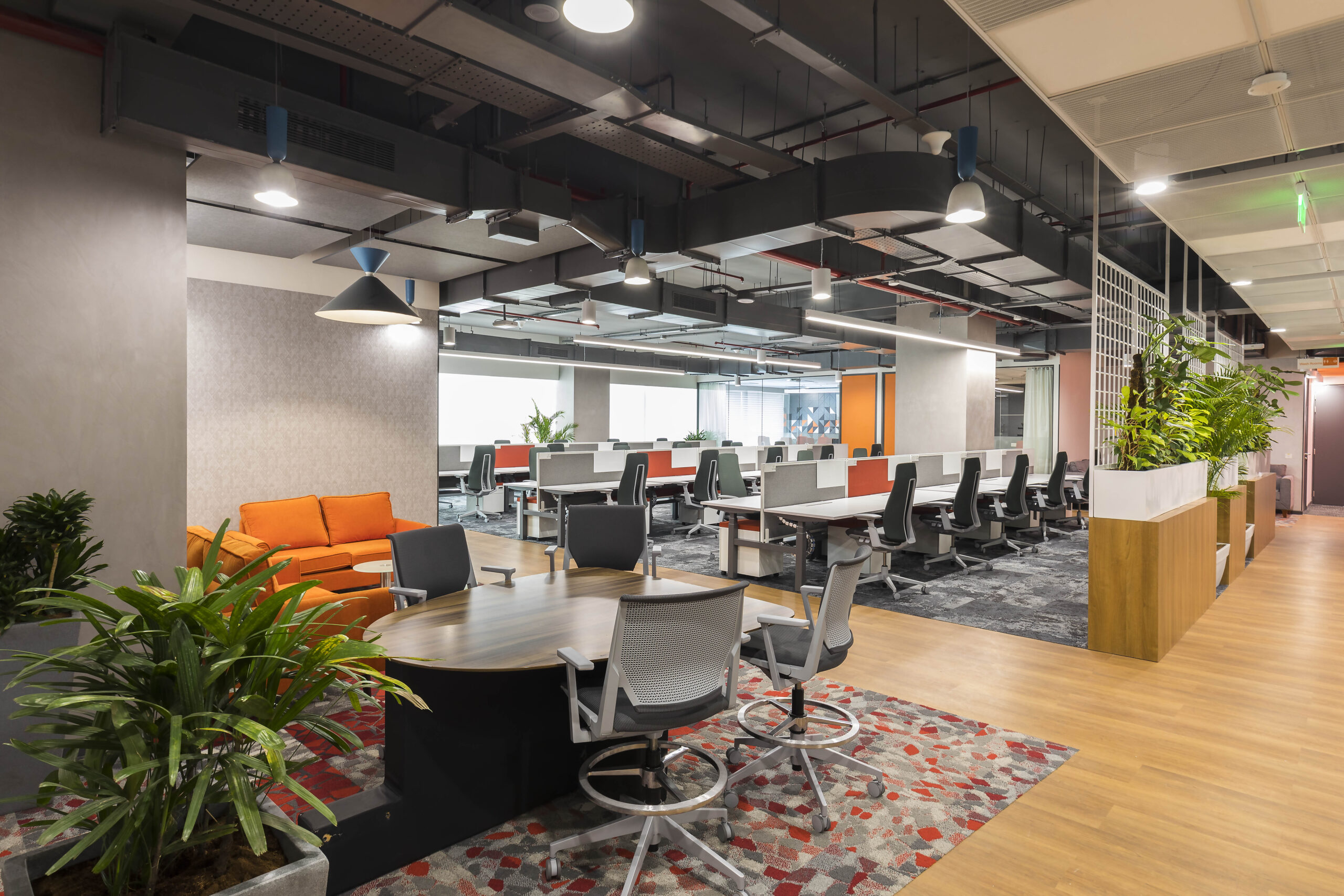
Living walls and planters: native Indian species (Areca palm, snake plant, money plant) are low-maintenance, highly effective air purifiers in Indian climates

Jali-inspired screens and perforated panels create dappled light patterns that activate the same neurological responses as natural foliage

Natural materials reclaimed teak, Kota stone, cane, rattan bring authentic texture and reduce synthetic off-gassing simultaneously

Courtyard-inspired atria and sky-lit break zones address India’s urban employee’s acute deprivation of natural light during 9-hour office days

$109BIndia’s smart building market projected by 2033 at 24.2% CAGR with BEE projecting 25% of new commercial buildings will be NZEB-certified by 2025. Smart building tech is India’s fastest-growing sustainability infrastructure segment (IMARC, 2025)

Eleganz Perspective

Eleganz’s integrated AV and smart controls capability means we design the Building Intelligence Layer alongside the interior, not after it. Sensor zones, conduit routes, and IAQ monitoring points are resolved at schematic design stage, ensuring smart systems are embedded in the architecture, not bolted on as an afterthought.

share this blog

Ready to start your project? Connect with Eleganz seamlessly.

Contact Info
UP

Amazon

Lorem Ipsum is simply dummy text of the printing and typesetting industry. Lorem Ipsum has been the industry's standard dummy text ever since the 1500s, when an unknown printer took a galley of type and scrambled it to make a type specimen book. It has survived not only five centuries

Amazon

Lorem Ipsum is simply dummy text of the printing and typesetting industry. Lorem Ipsum has been the industry's standard dummy text ever since the 1500s, when an unknown printer took a galley of type and scrambled it to make a type specimen book. It has survived not only five centuries